
Table of Contents
Velocity Ratio of a Belt Drive – Formula, Explanation and Calculation
A belt drive is a mechanical power-transmission system used to transfer rotary motion from one shaft to another. It generally consists of a driving pulley, a driven pulley, and a belt connecting the two.
One of the most important parameters in belt-drive design is the velocity ratio. It tells us how the speed of the driven pulley compares with the speed of the driving pulley.
What is the Velocity Ratio of a Belt Drive?
The velocity ratio of a belt drive is defined as:
Velocity Ratio = Speed of follower / Speed of driver
Let:
- d1 = Diameter of the driver pulley
- d2 = Diameter of the follower or driven pulley
- N1 = Speed of the driver in r.p.m.
- N2 = Speed of the follower in r.p.m.
Derivation of Velocity Ratio
For a belt drive without slip, the distance traveled by the belt over the driver in one minute is equal to the distance traveled over the driven pulley.
The length of belt passing over the driver in one minute is:
π d1 N1
Similarly, the length of belt passing over the driven pulley in one minute is:
π d2 N2
Therefore:
π d1 N1 = π d2 N2
Canceling π from both sides:
d1N1 = d2N2
Rearranging the equation:
N2 / N1 = d1 / d2
Therefore, the basic velocity-ratio formula for a belt drive is:
Velocity Ratio = N2 / N1 = d1 / d2
Calculation Example 1: Basic Belt Drive
Given:
- Driver diameter, d1 = 100 mm
- Driven pulley diameter, d2 = 200 mm
- Driver speed, N1 = 1440 r.p.m.
Find the speed of the driven pulley.
Using:
N2 / N1 = d1 / d2
Substituting the values:
N2 / 1440 = 100 / 200
Therefore:
N2 / 1440 = 0.5
Hence:
N2 = 1440 × 0.5
N2 = 720 r.p.m.
Answer: The driven pulley rotates at 720 r.p.m.
Since the driven pulley is twice the diameter of the driver, its speed is half the driver’s speed.
Velocity Ratio When Belt Thickness is Considered
When the thickness of the belt is significant, the belt does not run exactly along the pulley diameter. Therefore, belt thickness t must be considered.
The velocity ratio then becomes:
N2 / N1 = (d1 + t) / (d2 + t)
Where:
- t = Thickness of the belt
Calculation Example 2: Considering Belt Thickness
Suppose:
- d1 = 100 mm
- d2 = 200 mm
- N1 = 1440 r.p.m.
- t = 5 mm
Using:
N2 / N1 = (d1 + t) / (d2 + t)
Substitute the values:
N2 / 1440 = (100 + 5) / (200 + 5)
N2 / 1440 = 105 / 205
N2 / 1440 = 0.5122
Therefore:
N2 = 1440 × 0.5122
N2 ≈ 737 r.p.m.
Answer: Considering a 5 mm belt thickness, the driven pulley speed is approximately 737 r.p.m.
Velocity Ratio Using Peripheral Velocity
The velocity ratio can also be obtained by considering the peripheral velocity of the belt.
The peripheral velocity of the belt on the driving pulley is:
v1 = πd1N1 / 60
where v1 is in m/s when the pulley diameter is expressed in metres.
The peripheral velocity on the driven pulley is:
v2 = πd2N2 / 60
When there is no slip between the belt and pulleys:
v1 = v2
Therefore:
πd1N1 / 60 = πd2N2 / 60
After canceling the common terms:
d1N1 = d2N2
Thus:
N2 / N1 = d1 / d2
Calculation Example 3: Peripheral Velocity
Consider a driving pulley with:
- Diameter = 300 mm = 0.3 m
- Speed = 1000 r.p.m.
The belt velocity is:
v = πdN / 60
Substituting the values:
v = (π × 0.3 × 1000) / 60
v ≈ 15.71 m/s
Therefore, the belt travels at approximately 15.71 m/s.
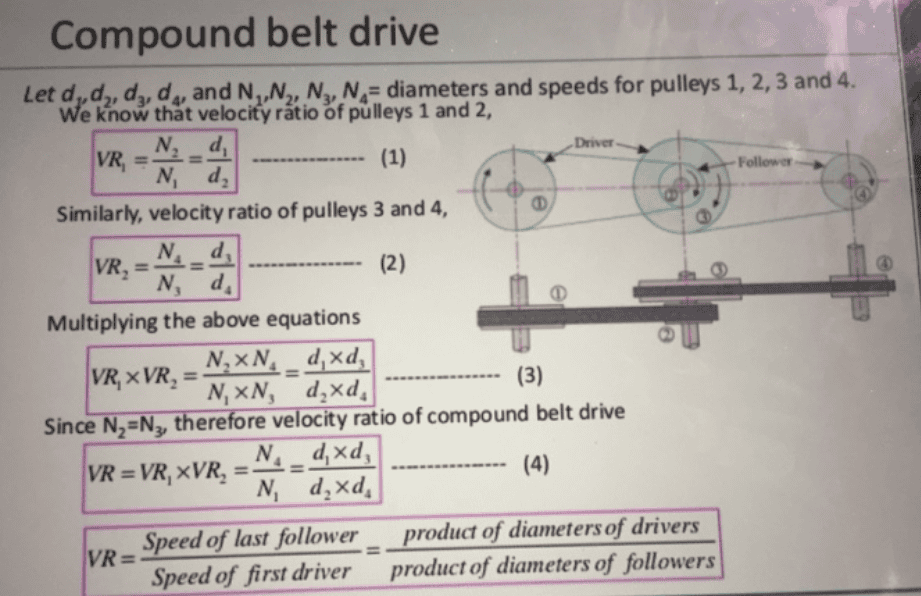
Velocity Ratio of a Compound Belt Drive
A compound belt drive uses more than one belt-and-pulley stage to obtain a larger change in speed.
For a compound belt drive, the velocity ratio is:
N4 / N1 = (d1 × d3) / (d2 × d4)
Where:
- N1 = Speed of the first driver
- N4 = Speed of the final driven pulley
- d1, d3 = Diameters of the drivers
- d2, d4 = Diameters of the driven pulleys
Therefore:
Speed of last driven pulley / Speed of first driver = Product of diameters of drivers / Product of diameters of driven pulleys
Calculation Example 4: Compound Belt Drive
Given:
- d1 = 100 mm
- d2 = 200 mm
- d3 = 150 mm
- d4 = 300 mm
- N1 = 1440 r.p.m.
Using:
N4 / N1 = (d1 × d3) / (d2 × d4)
Substituting the values:
N4 / 1440 = (100 × 150) / (200 × 300)
N4 / 1440 = 15000 / 60000
N4 / 1440 = 0.25
Therefore:
N4 = 1440 × 0.25
N4 = 360 r.p.m.
Answer: The final driven pulley rotates at 360 r.p.m.
Important Points to Remember
- For a simple belt drive without slip:N2 / N1 = d1 / d2
- A larger driven pulley results in a lower driven speed.
- A smaller driven pulley results in a higher driven speed.
- When belt thickness is considered:N2 / N1 = (d1 + t) / (d2 + t)
- The peripheral velocity of the belt is:v = πdN / 60
- For a compound belt drive:N4 / N1 = (d1d3) / (d2d4)
- These basic equations assume that there is no slip between the belt and pulleys.
Conclusion
The velocity ratio of a belt drive is a fundamental concept in mechanical engineering and machine design. It allows engineers and students to determine the speed of a driven shaft from the pulley diameters and the driver speed.
For a simple belt drive, the most important equation to remember is:
N2 / N1 = d1 / d2
When belt thickness is considered:
N2 / N1 = (d1 + t) / (d2 + t)
These formulas are useful for solving belt-drive problems, selecting suitable pulley sizes, and calculating the operating speed of belt-driven machines.
Related Topic: Understanding velocity ratio is an essential step before studying belt-drive power transmission, slip, creep, belt tensions, and centrifugal tension.
FAQ Section
What is the velocity ratio of a belt drive?
The velocity ratio of a belt drive is the ratio of the speed of the driven pulley to the speed of the driving pulley. For a belt drive without slip:
N₂/N₁ = d₁/d₂
What is the formula for belt drive velocity ratio?
The basic formula is:
N₂/N₁ = d₁/d₂
where N₁ and N₂ are the driver and driven speeds, while d₁ and d₂ are their respective pulley diameters.
How do you calculate the speed of a driven pulley?
Use:
N₂ = N₁ × d₁/d₂
For example, if a 100 mm driver rotates at 1440 rpm and drives a 200 mm pulley:
N₂ = 1440 × 100/200 = 720 rpm.
How does belt thickness affect velocity ratio?
When belt thickness is considered, the velocity ratio becomes:
N₂/N₁ = (d₁ + t)/(d₂ + t)
where t is the belt thickness.
What is the velocity ratio of a compound belt drive?
For a compound belt drive:
N₄/N₁ = (d₁ × d₃)/(d₂ × d₄)
This equation is used when multiple pulley stages are connected.
Related posts:
 AutoCAD Basic Interface – AutoCAD Window Explained
  What are the types Of Air Conditioning | Basic Of Air Conditioning
  Air conditioning- Types, Diagram, Working, Applications
  Design and Fabrication of Automated Glass Cleaning Machine
  Windows air Conditioning | Working , Components and Application
  CAD Tut 4. Do this Initial Setting Before Starting any AutoCad Drawings.
  CAD Tut 3. Use of Status Bar and Visual reference- Ortho,Snap,Grid,Polar Tracking
  Fabrication of Hydraulic Fork lift Project Report Download
Recent Posts
AI in AutoCAD and SolidWorks: Complete Guide for Mechanical Engineers (2026)
Artificial Intelligence (AI) is revolutionizing almost every engineering industry, and Computer-Aided Design (CAD) software is no exception. Mechanical engineers, product designers, architects, and...
Aluminium Alloys: Types, Composition, Properties, Heat Treatment & Applications
Introduction Aluminium is one of the most widely used engineering materials because of its lightweight, corrosion resistance, excellent thermal conductivity, and good machinability....