
Table of Contents
Introduction
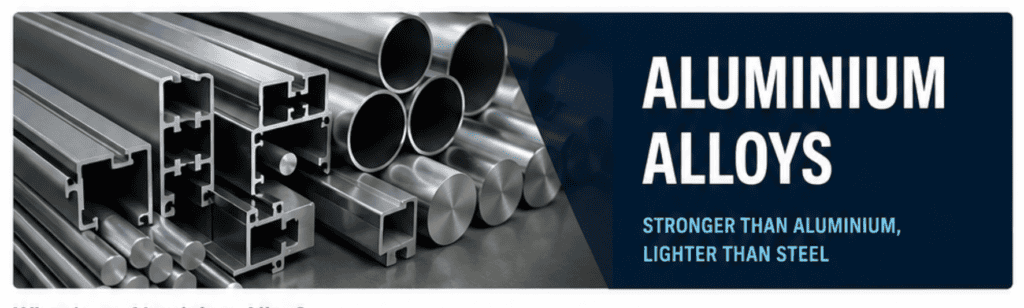
To improve its mechanical properties, aluminium is alloyed with elements such as Copper (Cu), Magnesium (Mg), Manganese (Mn), Silicon (Si), Nickel (Ni), and Chromium (Cr). These alloying elements significantly increase hardness, tensile strength, wear resistance, and heat resistance while maintaining aluminium’s low weight.
Today, aluminium alloys are extensively used in:
- Aerospace industry
- Automobile manufacturing
- Railway coaches
- Marine engineering
- Construction
- Electrical applications
- Consumer products
What is an Aluminium Alloy?
An aluminium alloy is a combination of aluminium with one or more alloying elements to improve its mechanical and physical properties.
Benefits of Alloying Aluminium
- Higher tensile strength
- Better hardness
- Improved wear resistance
- Better corrosion resistance
- Improved machinability
- Excellent strength-to-weight ratio
- Higher fatigue strength
Types of Aluminium Alloys
The most commonly used engineering aluminium alloys include:
- Duralumin
- Y-alloy
- Magnalium
- Hindalium
1. Duralumin
Composition
| Element | Percentage |
|---|---|
| Copper | 3.5–4.5% |
| Manganese | 0.4–0.7% |
| Magnesium | 0.4–0.7% |
| Aluminium | Balance |
Properties
- Tensile strength up to 400 MPa
- Excellent strength-to-weight ratio
- Good fatigue resistance
- High hardness after heat treatment
- Easily forged and rolled
One of the unique characteristics of Duralumin is Age Hardening (Precipitation Hardening). After solution heat treatment, the alloy naturally hardens over several days at room temperature.
Heat Treatment
- Solution heat treated
- Quenched
- Naturally aged for 3–4 days
Applications
- Aircraft structures
- Rivets
- Connecting rods
- Pulleys
- Bars
- Tubes
- Forgings
- Automotive components
2. Y-Alloy
Composition
| Element | Percentage |
|---|---|
| Copper | 3.5–4.5% |
| Manganese | 1.2–1.7% |
| Nickel | 1.8–2.3% |
| Silicon | 0.6% |
| Magnesium | 0.6% |
| Iron | 0.6% |
| Aluminium | Balance |
Properties
Y-alloy is a copper-based aluminium alloy specifically developed for high-temperature applications.
Advantages include:
- Excellent high-temperature strength
- Better machinability
- High wear resistance
- Good fatigue resistance
- Better heat resistance than Duralumin
Heat Treatment
Like Duralumin, Y-alloy undergoes:
- Solution treatment
- Natural ageing
- Age hardening for approximately five days
Applications
- Aircraft engine pistons
- Cylinder heads
- Cast components
- Forged components
- Aerospace engine parts
3. Magnalium
Composition
Magnalium contains:
- Aluminium
- Magnesium (2–10%)
- Copper (~1.75%)
Properties
- Extremely lightweight
- High mechanical strength
- Excellent corrosion resistance
- Good stiffness
- Easy machining
Applications
Magnalium is widely used in:
- Aircraft parts
- Automobile components
- Lightweight engineering products
- Defence equipment
4. Hindalium
Composition
Hindalium consists of:
- Aluminium
- Magnesium
- Small amount of Chromium
Properties
- Corrosion resistant
- Excellent surface finish
- Easily anodized
- Lightweight
- Good formability
Applications
Hindalium is commonly used for:
- Kitchen utensils
- Pressure cookers
- Storage containers
- Decorative sheets
- Household products
Comparison of Aluminium Alloys
| Alloy | Main Alloying Elements | Key Property | Applications |
|---|---|---|---|
| Duralumin | Cu + Mg + Mn | High Strength | Aircraft Structures |
| Y-Alloy | Cu + Ni + Mg | Heat Resistance | Aircraft Engines |
| Magnalium | Mg | Lightweight | Automotive & Aerospace |
| Hindalium | Mg + Cr | Corrosion Resistance | Kitchen Utensils |
Advantages of Aluminium Alloys
- Lightweight
- High strength
- Excellent corrosion resistance
- Good thermal conductivity
- Easy fabrication
- Recyclable
- Long service life
- Attractive appearance
Disadvantages
- Costlier than mild steel
- Lower hardness than alloy steel
- Reduced strength at very high temperatures (except special alloys)
- Some grades require heat treatment
Engineering Applications
Aluminium alloys are used in numerous industries:
- Aerospace
- Automotive
- Railway
- Marine
- Defence
- Robotics
- Construction
- Consumer electronics
- Electrical transmission
- Medical equipment
Frequently Asked Questions (FAQs)
Which aluminium alloy is strongest?
Duralumin is among the strongest traditional aluminium alloys, with tensile strength reaching approximately 400 MPa after heat treatment.
Why is Y-alloy used in aircraft engines?
Y-alloy maintains its strength at elevated temperatures, making it suitable for engine pistons and cylinder heads.
What is Age Hardening?
Age hardening is a heat-treatment process in which an aluminium alloy gains strength over time after solution treatment due to the formation of fine precipitates.
Is Hindalium pure aluminium?
No. Hindalium is an aluminium alloy containing magnesium and a small amount of chromium, offering improved corrosion resistance and formability.
Conclusion
Aluminium alloys have transformed modern engineering by combining light weight with high strength, corrosion resistance, and excellent manufacturability. Among the most widely used are Duralumin, Y-alloy, Magnalium, and Hindalium, each designed for specific engineering applications ranging from aircraft structures to household utensils.
Understanding their composition, heat treatment, and applications helps engineers select the most suitable material for reliable, high-performance designs.
Related posts:
 AutoCAD Basic Interface – AutoCAD Window Explained
  Air conditioning- Types, Diagram, Working, Applications
  What are the types Of Air Conditioning | Basic Of Air Conditioning
  Design and Fabrication of Automated Glass Cleaning Machine
  Windows air Conditioning | Working , Components and Application
  3 Steps Of Heat Treatment Process | Basic Of Heat Treatment
  Physical Properties Of Aluminium – Aluminium Uses and Application
  Heat treatment problem – Heat treatment Defects
Recent Posts
Velocity Ratio of Belt Drive – Formula, Explanation and Calculation
Velocity Ratio of a Belt Drive – Formula, Explanation and Calculation A belt drive is a mechanical power-transmission system used to transfer rotary motion from one shaft to another. It generally...
AI in AutoCAD and SolidWorks: Complete Guide for Mechanical Engineers (2026)
Artificial Intelligence (AI) is revolutionizing almost every engineering industry, and Computer-Aided Design (CAD) software is no exception. Mechanical engineers, product designers, architects, and...