
Table of Contents
Projection Method | First And Third Angle Projection | Difference
Projection Methods:
Projection Methods are used to show drawing on a paper . Projection Methods has mainly two types used in Engineering Drawing :
1) First Angle Projection Method
2) Third Angle Projection Method

First Angle Projection
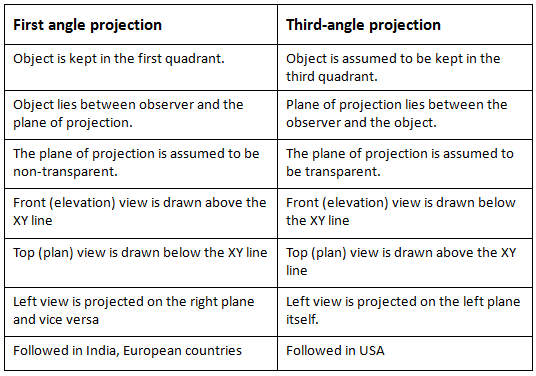
In this the object in assumed to be positioned in the first quadrant and is shown in figure.

The object is assumed to be positioned in between the projection planes and the observer. The views are obtained by projecting the images on the respective planes. Note that the right hand side view is projected on the plane placed at the left of the object. After projecting on to the respective planes, the bottom plane and left plane is unfolded on to the front view plane. i.e. the left plane is unfolded towards the left side to obtain the Right hand side view on the left side of the Front view and aligned with the Front view. The bottom plane is unfolded towards the bottom to obtain the Top view below the Front view and aligned with the Front View.
Third Angle Projection

Difference between first- and third-angle projections
Symbol of projection

More Resources /articles
Fluid Mechanics - Notes , articles , Interview Que. & Ans
Engineering Drawing- Articles , Notes , Interview Q & A
Mechanical Subjectwise Basic Concept Notes ,Articles
Latest seminar topic index - Report ,PPT Download
Latest seminar topic index - Report ,PPT Download
Related posts:
 Engineering Drawing Basic | Interview Question and Answers – Part 3
  Engineering Drawing Basic | Interview Question and Answers – Part 4
  Engineering Drawing Online Notes , Objective and Interview Questions
  What is Engineering Drawing | Basic of Machine drawing Engineering Drawing Basic | Interview Question and Answers – Part 2
  What is Projection Welding | Advantages , Application
  Some Dimensioning Techniques Used in Machine drawing
  Design And Fabrication Of Tilting and Angle Vice
3 thoughts on “Projection Method | First And Third Angle Projection | Difference”
Leave a Reply
Recent Posts
Velocity Ratio of Belt Drive – Formula, Explanation and Calculation
Velocity Ratio of a Belt Drive – Formula, Explanation and Calculation A belt drive is a mechanical power-transmission system used to transfer rotary motion from one shaft to another. It generally...
AI in AutoCAD and SolidWorks: Complete Guide for Mechanical Engineers (2026)
Artificial Intelligence (AI) is revolutionizing almost every engineering industry, and Computer-Aided Design (CAD) software is no exception. Mechanical engineers, product designers, architects, and...
thank you
Thank you..